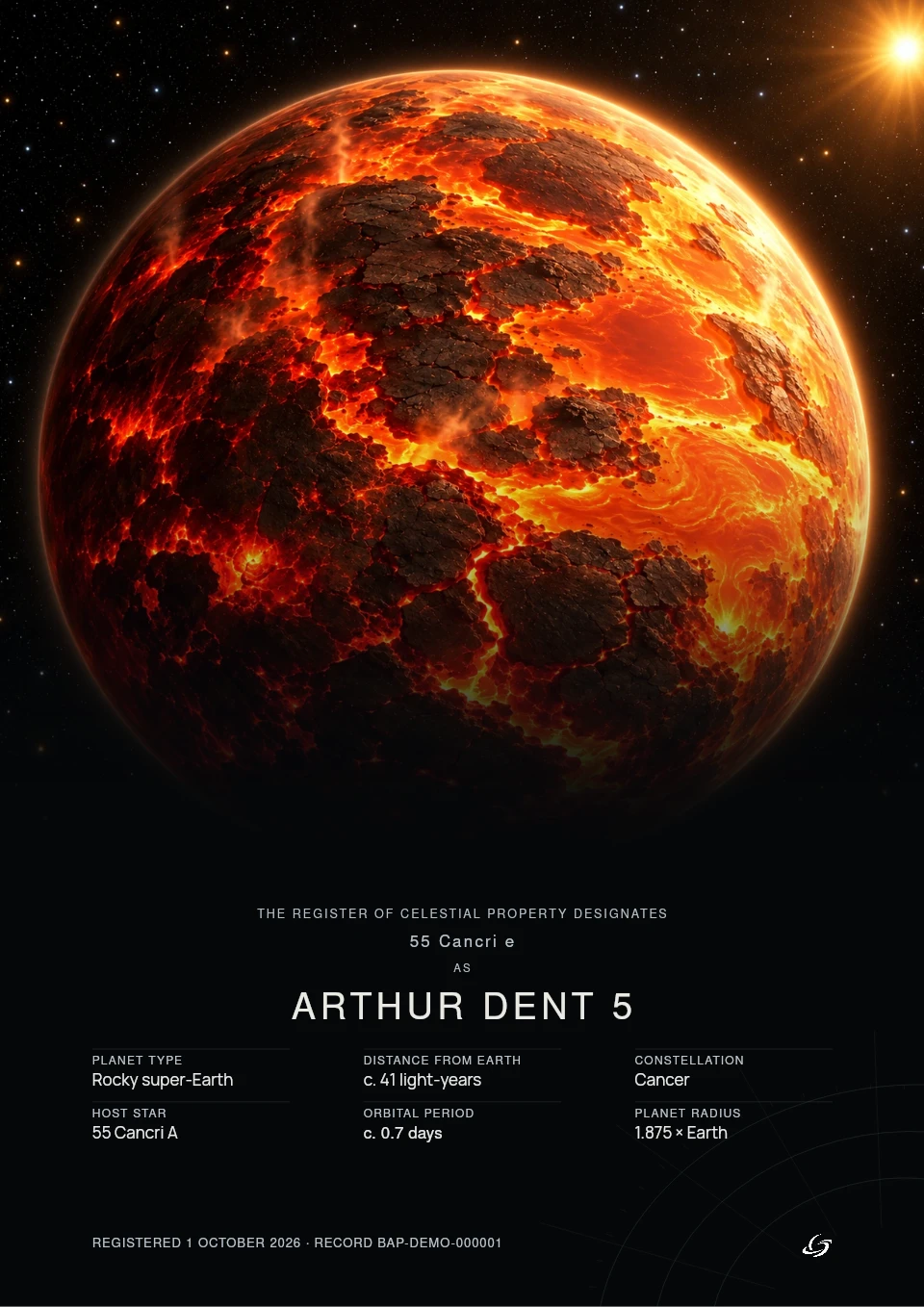
A3 or A4 artwork
Your selected planet, your chosen name and genuine astronomical details in our approved print design. Choose A4 or A3 for a physical print.
High-resolution digital artwork is included with every package.

 Claim This Planet
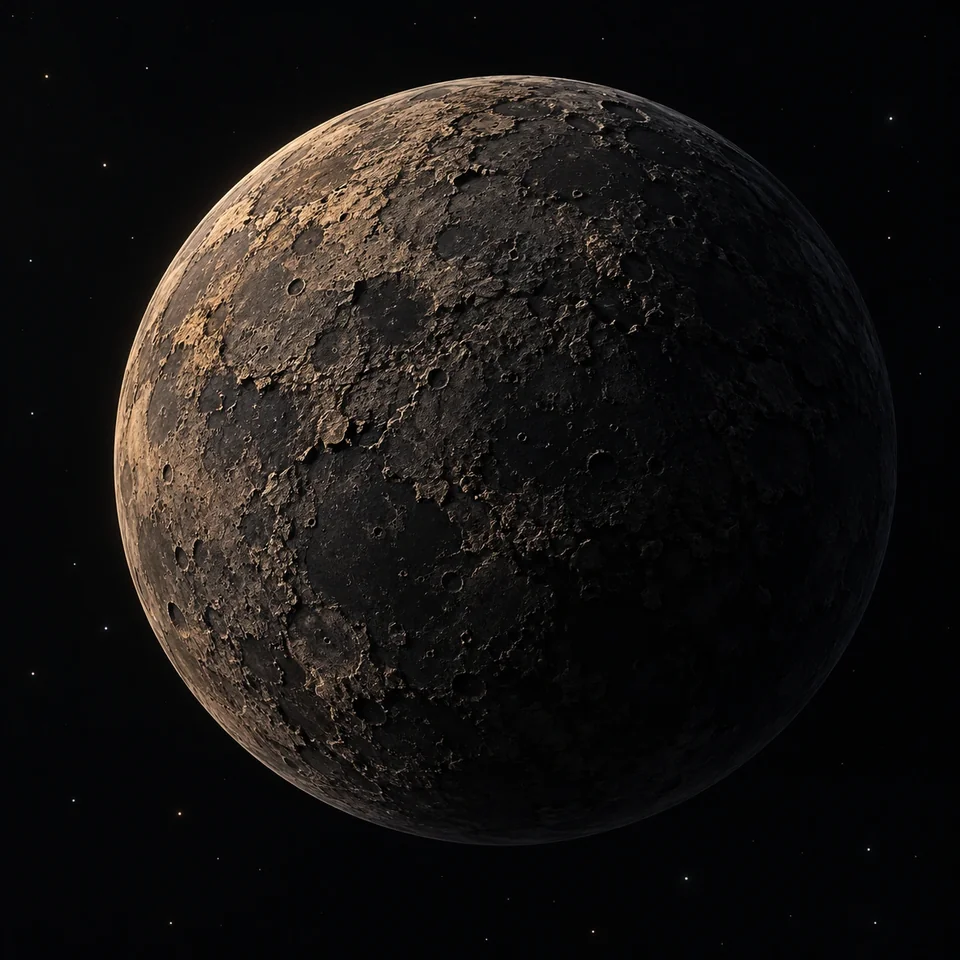
Buy A Galaxy · original commissioned reconstruction
Artist's Reconstruction · View astronomy source
Artist's ReconstructionFull image credit, source & interpretation
Artist's reconstruction based on published astronomical observations and current scientific understanding.
Official catalogue designation: LHS 3844 b
Your name for it: ARTHUR DENT 5
A dark, intensely heated rocky world that circles a red dwarf in about eleven hours. Infrared observations favour a bare surface with little or no substantial atmosphere.
Values are rounded estimates and may be refined by further observations. Personal names remain ceremonial.
Claim This PlanetA personalised planet gift preview. No order or reservation is made.
A larger A3 poster with a separate A4 printed certificate and printed factsheet. UK and US delivery available. Includes the full digital pack: artwork, certificate, factsheet and desktop/mobile wallpapers.
Paper sizes shown in proportion. Tap either piece to inspect your personalisation.
Live preview · your selected galaxy and personalisation.
Registration number is a demonstration, not a saved registry entry. Artwork image credit
Explore each item to see what’s included.
Your selected planet, your chosen name and genuine astronomical details in our approved print design. Choose A4 or A3 for a physical print.
High-resolution digital artwork is included with every package.
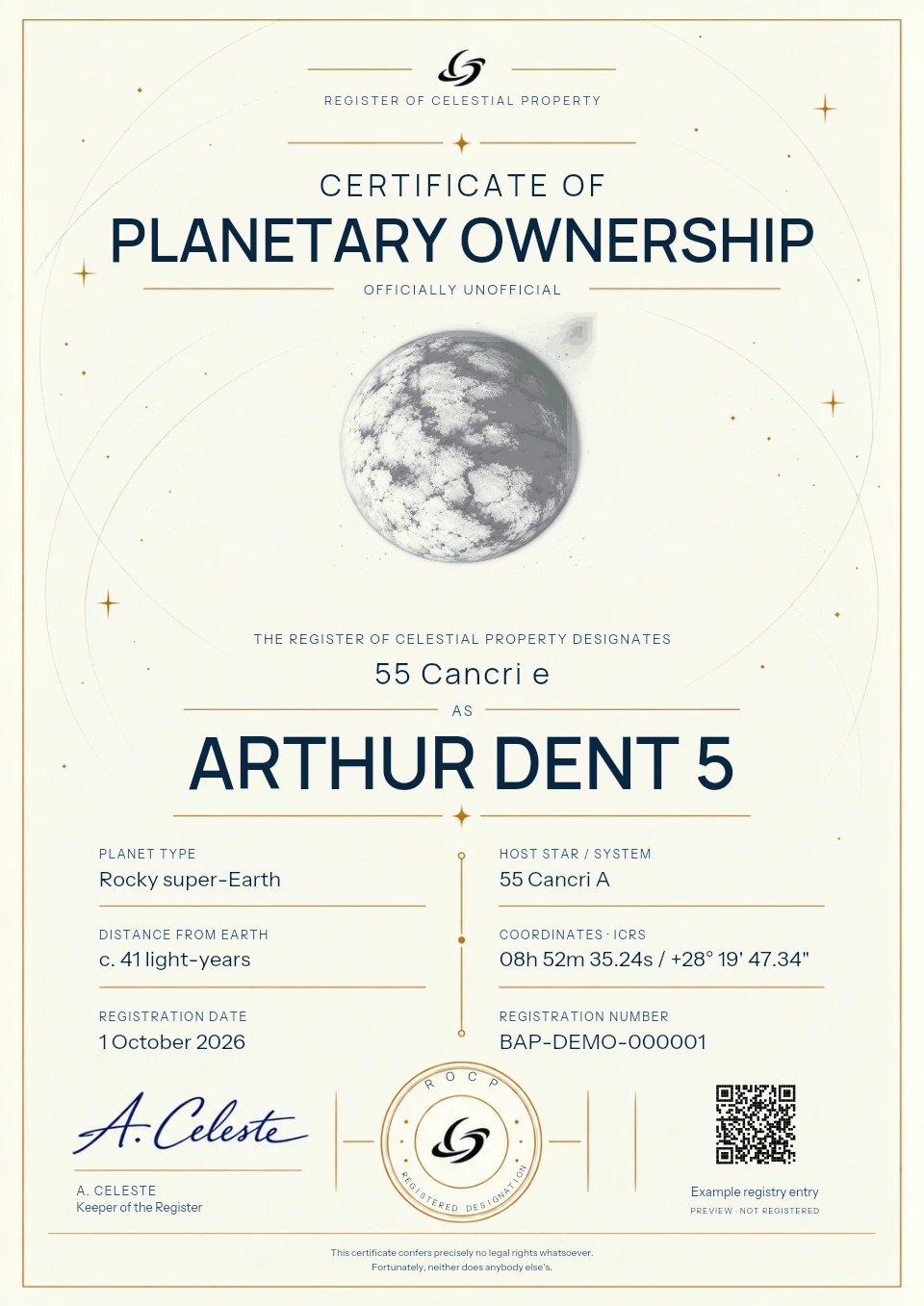
A matching commemorative certificate, with your registered name, object designation, registration number and QR link to its registry record.
Digital copy in every package. Printed editions also include an A4 physical certificate.
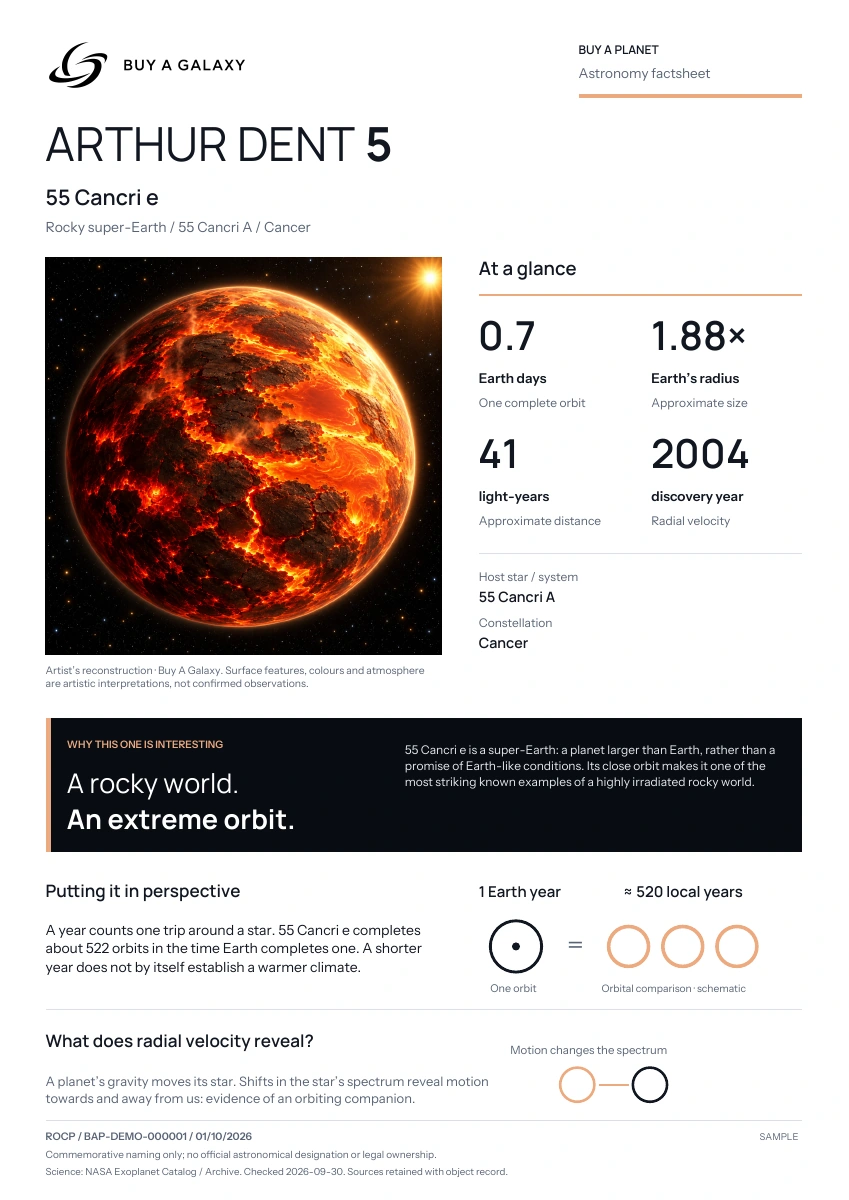
A personalised, single-page guide to your planet: interesting science, key measurements and the distinction between known facts and artistic interpretation.
Digital copy in every package; a printed sheet in Printed Editions.


Your planet artwork, given room to breathe. Clean, text-free wallpapers for 1920 × 1080, 2560 × 1440 and 3840 × 2160 displays. Included in every digital pack.


Dedicated portrait compositions with space around the clock and widgets. Supplied at 1290 × 2796 and 1440 × 3200, using the same celestial artwork as your gift.
 REGISTER OF CELESTIAL PROPERTYIllustrative record
55 Cancri e
Your certificate’s QR code links to a lasting digital record of the registration.
Catalogue records are private. Pick Your Own records can be public or unlisted, according to your selection. Contact and billing details stay private.
Every package includes your personalised digital artwork, certificate, factsheet and wallpapers. Printed editions also include the professionally produced physical artwork and certificate.
Illustrative examples. Gallery Edition framed presentation is coming soon.
Values are rounded from published catalogue measurements. Sky coordinates identify the host system, not a resolved planetary surface.
LHS 3844 b completes an orbit in about eleven hours. Its radius is roughly 1.29 times Earth’s, making it a rocky super-Earth. The host is a small, cool red dwarf about 49 light-years away.
Spitzer measurements suggested that heat is poorly redistributed from day to night. Webb’s 2026 infrared spectrum strengthens the picture of a hot, dark rocky surface without a substantial atmosphere.
The Webb spectrum is compatible with several dark rock types, including basaltic and other low-silica compositions. It does not establish one exact rock recipe, and it does not resolve a map of mountains or craters.
Our reconstruction uses restrained warm grazing light over a charcoal globe. The crater-like relief and local textures are invented to evoke a plausible airless rocky world. There is no asserted lava sea, ocean or atmospheric glow.
TESS detected the small recurring dip in the host star’s light when the planet passed in front of it. Later observations during eclipses allowed researchers to separate the planet’s infrared emission from the star’s.
It makes a striking commemorative print. The genuine designation, host-system coordinates and selected measurements stay visible alongside your chosen name. Holiday bookings are fortunately outside our remit.
Checked 1 October 2026. The source organisations do not endorse this gift.
 Hot Jupiter
A blue planet. Almost nothing like home.
 Ultra-hot Jupiter
An excellent choice for someone who likes it warm.
 Circumbinary gas giant
Two suns included. Energy bills remain theoretical.